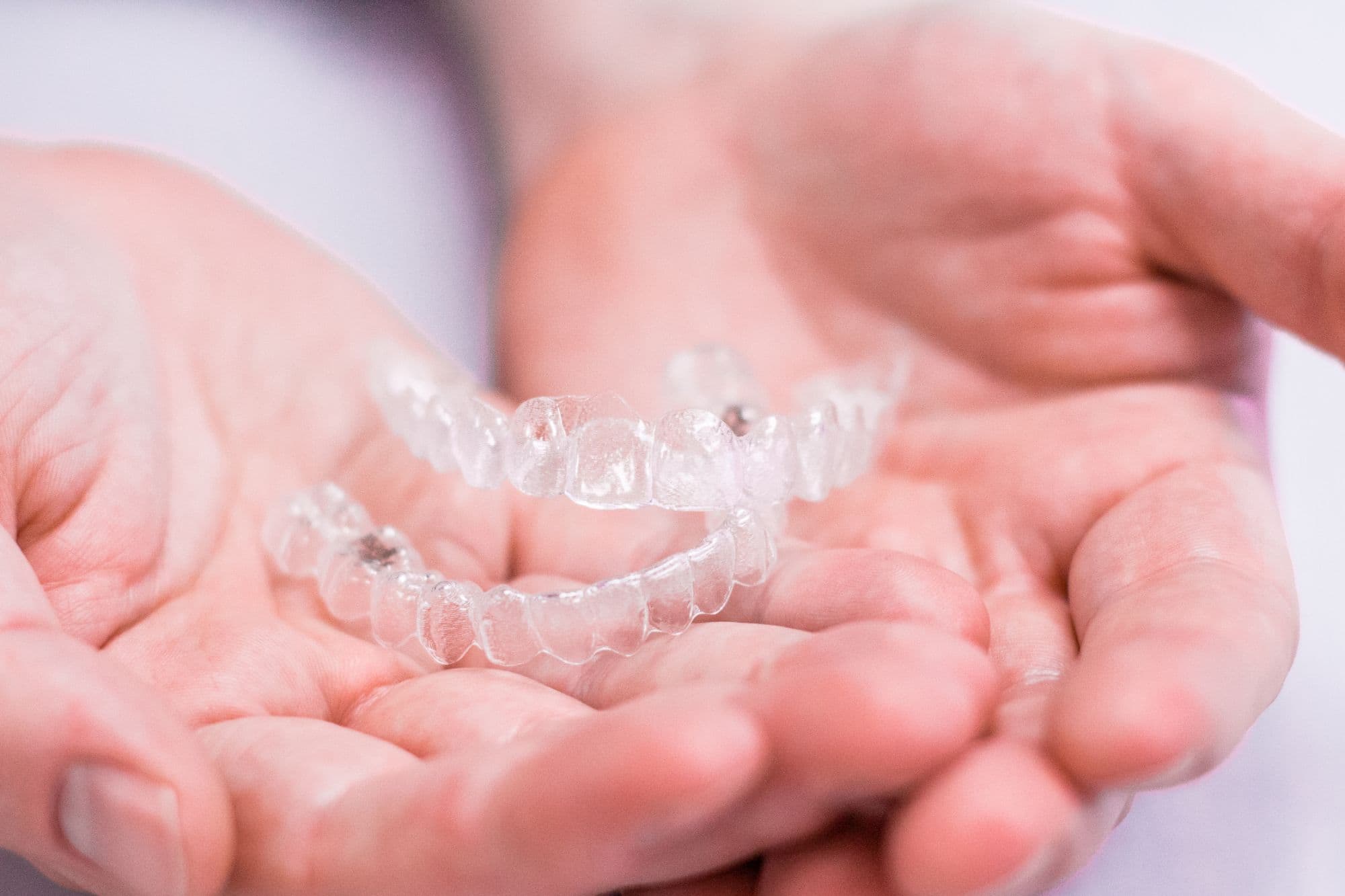
Braces and Invisalign both straighten teeth. They just go about it differently, and the right pick depends less on which one sounds better and more on what your bite actually needs. Metal brackets handle the widest range of cases. Clear aligners give you flexibility. Ceramic braces sit somewhere in between.
Dr. John Delplanche is a board-certified orthodontist and a Diplomate of the American Board of Orthodontics, and he treats children, teens and adults at our Beaverton practice. Here is how the three options compare, what each one is good at and where each one falls short.
Braces vs Invisalign vs Clear Braces at a Glance
All three move teeth using steady, controlled pressure. What changes is the appliance, how visible it is and how much of the work depends on you remembering to wear it.
| Feature | Metal Braces | Clear Braces | Invisalign |
|---|---|---|---|
| Visibility | Most noticeable | Tooth-colored and subtle | Nearly invisible |
| Durability | Extremely strong | Strong but can stain | Removable trays |
| Best For | Complex cases and all ages | Patients wanting discretion with bracket reliability | Mild to moderate cases and lifestyle flexibility |
| Maintenance | Brush around brackets | Extra care to prevent staining | Remove to eat and clean |
| Compliance | Always working | Always working | Requires 20 to 22 hours of daily wear |
How Metal Braces Work
Metal braces remain the most common choice, and for good reason. They are reliable, they handle complex cases that aligners cannot, and today’s brackets are smaller and more comfortable than the ones you remember. You can also customize the look with colored elastics.
The trade-off is visibility, and the fact that they are fixed in place. That is also their advantage. There is no wear schedule to keep up with, because they are working every hour of every day whether you think about them or not.
How Clear Braces Compare
Made from ceramic that blends with your teeth, clear braces offer the strength of traditional brackets with a more discreet look. They are a middle ground for patients who want something less visible but still prefer a fixed appliance.
They do need more care than metal. The brackets themselves resist staining, but the elastic ties around them can pick up color from coffee, tea, red wine and curry between adjustment visits. If that sounds like your diet, it is worth raising at your consultation.
How Invisalign Works
Invisalign uses custom-made removable trays that shift your teeth a little at a time. You take them out to eat, so nothing is off the menu, and you brush and floss exactly as you always have. Most people will not notice you are in treatment at all.
The catch is compliance. The trays only work while they are in your mouth, which means 20 to 22 hours a day, every day. Patients who treat that as a guideline rather than a rule end up in treatment longer than planned. For a self-motivated adult that is rarely an issue. For a distracted fourteen-year-old it sometimes is.
Which Option Fits Your Case?
Most of the decision comes down to what is being corrected. Orthodontic treatment addresses a specific set of problems, and some respond to any of the three approaches while others really do not.
- Crowding with teeth overlapping or twisted
- Gaps between teeth
- Overbite where upper teeth extend too far over lower teeth
- Underbite where lower teeth sit in front of upper teeth
- Crossbite when upper and lower teeth do not line up
- Open bite when front teeth do not meet biting down
Mild to moderate crowding and spacing generally work well with any of the three. Significant bite correction, severe rotations and cases needing substantial tooth movement usually call for fixed brackets, because they give an orthodontist more control over individual teeth. A small number of cases use both, starting in braces and finishing in aligners.
If you want to compare the fixed options more closely, there is a fuller breakdown of the different types of braces. Otherwise, the honest answer is that this is what a consultation is for. Dr. Delplanche will tell you which options are genuinely on the table for your case rather than which one you would prefer to hear about.
What Treatment Involves, Start to Finish
The path is the same whichever appliance you end up in. You start with a consultation, get a custom plan, have your appliance placed or fitted, come back for check-ins every few weeks, then move into retention to hold the result.
The Consultation
Treatment starts with a free consultation where Dr. Delplanche examines your teeth, takes 3D imaging with the iTero digital scanner with no gooey impressions, and talks through your smile goals.
Building the Plan
Using your diagnostic records, Dr. Delplanche builds a plan made for your case. He explains your options, the estimated treatment time and answers every question on your mind.
Placing the Appliance
Whether you go with metal braces, clear braces or Invisalign, your appliances are placed or fitted during a comfortable visit. Some patients qualify for same-day starts.
Check-In Visits
You will come in every four to eight weeks for adjustments. These visits are usually quick and they keep treatment on track.
Retention
Once your teeth reach their new positions, you wear retainers to hold them there. This phase matters as much as active treatment, and it is the step people most often underestimate.
Most cases finish in 18 to 24 months. Simpler cases wrap up sooner. Complex situations need more time.
Who Is a Good Candidate?
Treatment works for children, teens and adults. What changes with age is the approach, because growth stage affects what can be corrected and how quickly.
Children
The American Association of Orthodontists recommends a first check by age seven. At that point enough permanent teeth have come in to spot developing issues like crossbites, crowding or jaw growth problems. Early evaluation does not always mean early treatment, but it lets Dr. Delplanche track growth and step in at the right moment. This is sometimes called Phase 1 treatment, and it can reduce or prevent bigger problems later.
Teenagers
The teen years are still the most common time for treatment. Most permanent teeth are in and jaw growth is still happening, which makes it a good window for correction. It is also the age where the compliance question matters most when choosing between a fixed and a removable appliance.
Adults
It is never too late. Adult orthodontics has grown a great deal, and discreet options like Invisalign and clear braces make treatment realistic for people who skipped it as a kid or whose teeth shifted years after they finished.
The prerequisites are the same at any age. Healthy teeth and gums, since active decay or gum disease should be treated first. A willingness to follow care instructions. And the ability to make regular visits.
What Straighter Teeth Do Beyond Looks
Straight teeth are easier to clean. When teeth are not crowded or overlapping, brushing and flossing reach the spots that matter, which lowers cavity and gum disease risk. Properly aligned teeth also wear evenly, which helps prevent chips, cracks and uneven enamel loss over time.
A well-aligned bite works better day to day. Chewing is more efficient. Speech improves for some patients. And the strain that comes with a misaligned bite often eases, which can mean fewer headaches and less jaw discomfort.
Frequently Asked Questions
Does getting braces or Invisalign hurt?
When you first get braces or start a new set of aligners, your teeth and mouth may feel tender. That is normal and it usually fades within a few days. Over-the-counter medication and soft foods help during adjustment periods.
How long does treatment take?
Most cases finish in 18 to 24 months, though every case is different. Dr. Delplanche gives you an estimated timeline at your consultation rather than after you have started.
Can I switch from braces to Invisalign partway through?
Sometimes, and occasionally that is the plan from the start. Some cases begin in fixed brackets to handle the heavy lifting, then finish in aligners. It depends on what is left to correct at that point, so it is a conversation to have with your orthodontist rather than a decision to make on your own.
How often do I need to come in?
Every four to eight weeks during active treatment. These check-ins are usually quick and they are what keeps progress on track.
Can I play sports or instruments with braces?
Yes. A mouthguard is a good idea for contact sports to protect your braces and your teeth. Most patients adjust to playing wind instruments within a week or two. Let the team know about your activities and they can give you specific tips.
What happens if I do not wear my retainer?
Your teeth drift back toward their original positions. After putting in the time on treatment, retention is what protects the result, and it is worth understanding how retainers work before you finish.
Is a virtual consultation available?
Yes. Delplanche Orthodontics offers a virtual consultation option for patients who want to start from home. You share photos and information about your smile goals, and the team follows up with next steps.